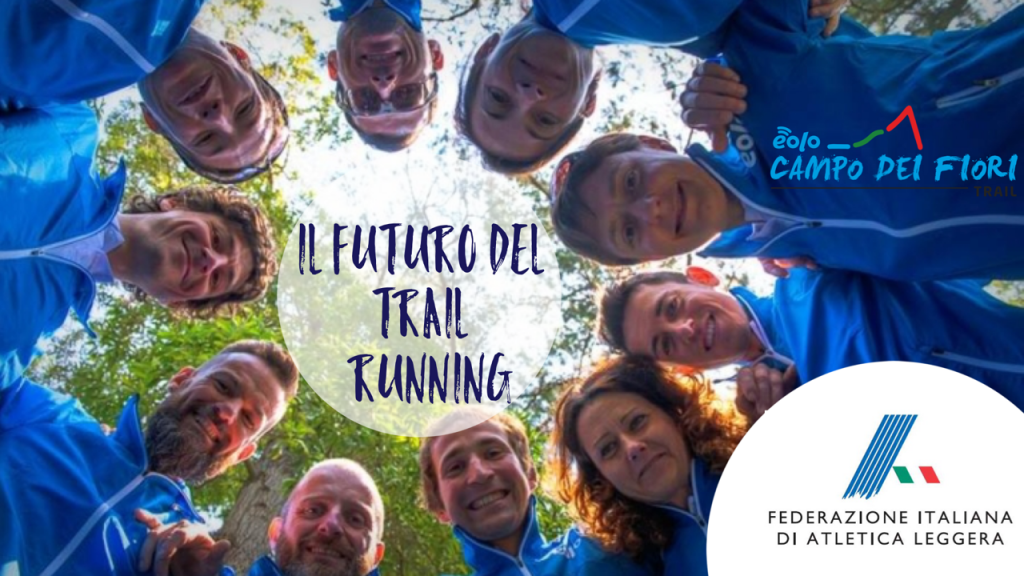
On the immediate eve of the Italian Long Trail Championships, at the Campo dei Fiori Trail, an interesting technical meeting was held in Gavirate (Va), in the splendid setting of the Voltorre Cloister, organised by the Organising Committee of the tricolour event and the Italian Athletics Federation, with the theme ”The near future of trail running”.
Introducing the meeting was the federal technical manager Paolo Germanetto, which then gave way to Fulvio Massa e Titus Tiberti, to go into more detail.
The intervention of Tito Tiberti
Running in nature is experiencing an important moment of evolution that is part of institutional change processes relevant to the future of the trail and mountain running disciplines.
Mountain Running and Trail running are officially disciplines of athletics (the entry of trail running dates back to the IAAF Congress in Beijing 2015). However, the regulatory and organisational history of the specialities of running in the wild is a history of fragmentation, both in terms of plurality of rules (within the IAAF Competition Rules we have Rule 251 on Mountain Running and Rule 252 on Trail) and plurality of entities that in various capacities deal with “trails”. Within the macro framework of the Olympic Committee, which delegates athletics to the IAAF (representing 214 countries or representations today, with the relevant National Federations and Continental Associations), there are also “sectoral” Associations such as WMRA and ITRA (to which a substantial but not exhaustive number of Athletics Federations or National Sectoral Associations belong). There are also associations that are involved in running in nature in various capacities and claim for themselves membership of more generic “mountain sports”, neglecting their affinity with athletics.
The process we are going through is a story of simplification and broadening of horizons for competitive off-road running, in more detail:
- WMRA and ITRA with IAAF are rewriting the rules and bringing them back to unity: there will soon be a single rule 251 for “Mountain and Trail Running”.
- The IAAF will first give total support and then assume ownership of the World Mountain Running and Trail Championships, with WMRA and ITRA being exclusive technical partners of the IAAF itself and with the possibility of participation expanding from the “particular” to the universal, potentially including all 214 IAAF members (more than four times as many as we see represented in the sectoral associations).
- Villa La Angostura (ARG) in November 2019 will host the first Mountain Running World Championship “supported by IAAF” with universal participation (official announcement on 1 August, in Buenos Aires).
- The first IAAF World Mountain and Trail Running Championships, organised with the technical support of WMRA and ITRA, will see the light of day in 2021 (official announcement on 28 August in Chamonix): universal participation as part of a major event (probably biennial) which will see the holding of Long Trail, Short Trail, Mountain “classic” (also under 20) and possibly also “Vertical” and Relay races.
Scenarios and possibilities are opening up for the movement, in which the “(mountain) running olympic dream” still remains a dream, but not utopia. The furrow traced is what CONI already declared in the “Sport Italia 2020 Report” in which it expressly spoke of a) competitive strengthening in the top disciplines and b) selective expansion of new disciplines or specialities for the Italian Olympics.
The intervention of Fulvio Massa
The 2019 Trail Running World Championships was a topic of great interest, and during the meeting, maximum attention was paid to the characteristics of the race and the anticipation regarding the selection criteria for the Italian representative team.
The characteristics of the 2019 World Cup
Place and date: TRILHOS DOS ABUTRES (Portugal) - 8 June 2019
Technical aspects: 43.5 km / 2040 D+ / min 100m - max 937 / max ascent 560m - max descent 700m
Criteria for convocation
The official criteria will be approved by the Federal Council in the near future, but the Technical Directorate has decided to divulge the guidelines that will lead to the athletes' choice of the best programming well in advance.
Up to six men and six women will be eligible, of whom three on the basis of technical choices according to the rainbow route and three following a qualifying race.
The winner of the 2018 Italian title will have a right of first refusal, but not the certainty of a call-up, and will still have to prove his or her form in the appropriate ways and fora.
Before the official convocations, it will be necessary to verify the athletes' actual state of health, and with this in mind, the maximum transparency and willingness to
share their schedules from the moment of selection until the day of the world championship.
This means that the athlete or, if applicable, his coach, will share with the Technical Management the general athletic programme he will carry out during that period and the scheduled competitions will be analysed; during this period, the selected athlete will not be allowed to compete in competitions that are not in agreement with the Technical Management.
The identification of a qualifying race as the basic element of the selection criteria has been confirmed. The race will have technical characteristics similar to the World Cup race, in terms of mileage, altitude difference and environmental characteristics, and a time frame functional to the preparation for the World Cup. It must also be a race that relies on federal standards and regulations and is supported by an organisation that has proven its efficiency.
The selected test will therefore be “Maremontana” - www.maremontana.it - scheduled to take place in Loano (Sv) on 31 March 2019 with these characteristics: 45 km -2600+.
The qualifying race represents three milestones from a technical point of view.
In the first instance, if placed in an appropriate time period, it is an indication of the athlete's state of fitness in relation to a similar course to the world championship.
Then, the athlete who performs well in the qualifying competition must have carried out a period of programming that has led him or her logically up to that point and thus means that he or she has accepted and shared the project.
The qualifying competition also represents the policy of comparison, i.e. a framework within which all the best Italian athletes can compare themselves, because only through direct comparison can true growth in level be achieved.
For any information or doubts please write to: info@campodeifioritrail.it